Process mining in healthcare uses the timestamps your hospital information system already records to rebuild what actually happened to every patient, in order, across every department they passed through. Not a sample. Not a workshop diagram. Every case. For hospitals trying to fix patient flow, that distinction is the whole ballgame, because the delays that hurt patients rarely sit inside one department. They sit in the gaps between them, where nobody owns the clock.
This article covers what process mining in healthcare is, what it reveals about patient flow that dashboards miss, where hospitals apply it first, the data and privacy obstacles you should plan for, and how to scope a first project that produces something useful within a quarter.
What process mining in healthcare actually is
Every time a clinician orders a test, a bed is assigned, a result is filed, or a discharge summary is signed, your systems write a row with a timestamp and an identifier. Process mining reads those rows and reassembles them into the real sequence of events for each patient, then aggregates thousands of those sequences into a map of how care actually flows.
Three ingredients make it work:
- Event data. A case identifier such as an encounter or visit number, an activity name, and a timestamp. Most hospital information systems, EHRs, lab systems, and scheduling tools already produce this as a byproduct of normal operation.
- A discovered model. The map that comes out of the data, showing every route patients actually took, including the rare and expensive ones nobody documented.
- Comparison against intent. Your care pathway or protocol as it is supposed to run, checked against what the data says happened, so the gaps are measurable rather than anecdotal.
The result is not another dashboard. A dashboard tells you the average length of stay went up. Process mining tells you which route those patients took, where in that route the clock ran, and how many cases took it.
Why patient flow is so hard to see
Hospitals are unusually good at measuring departments and unusually bad at measuring journeys. The emergency department has a door to doctor metric. Radiology has a turnaround target. The lab reports on result time. Bed management tracks occupancy. Every one of those can look healthy while a patient sits for two days waiting on something nobody has a metric for.
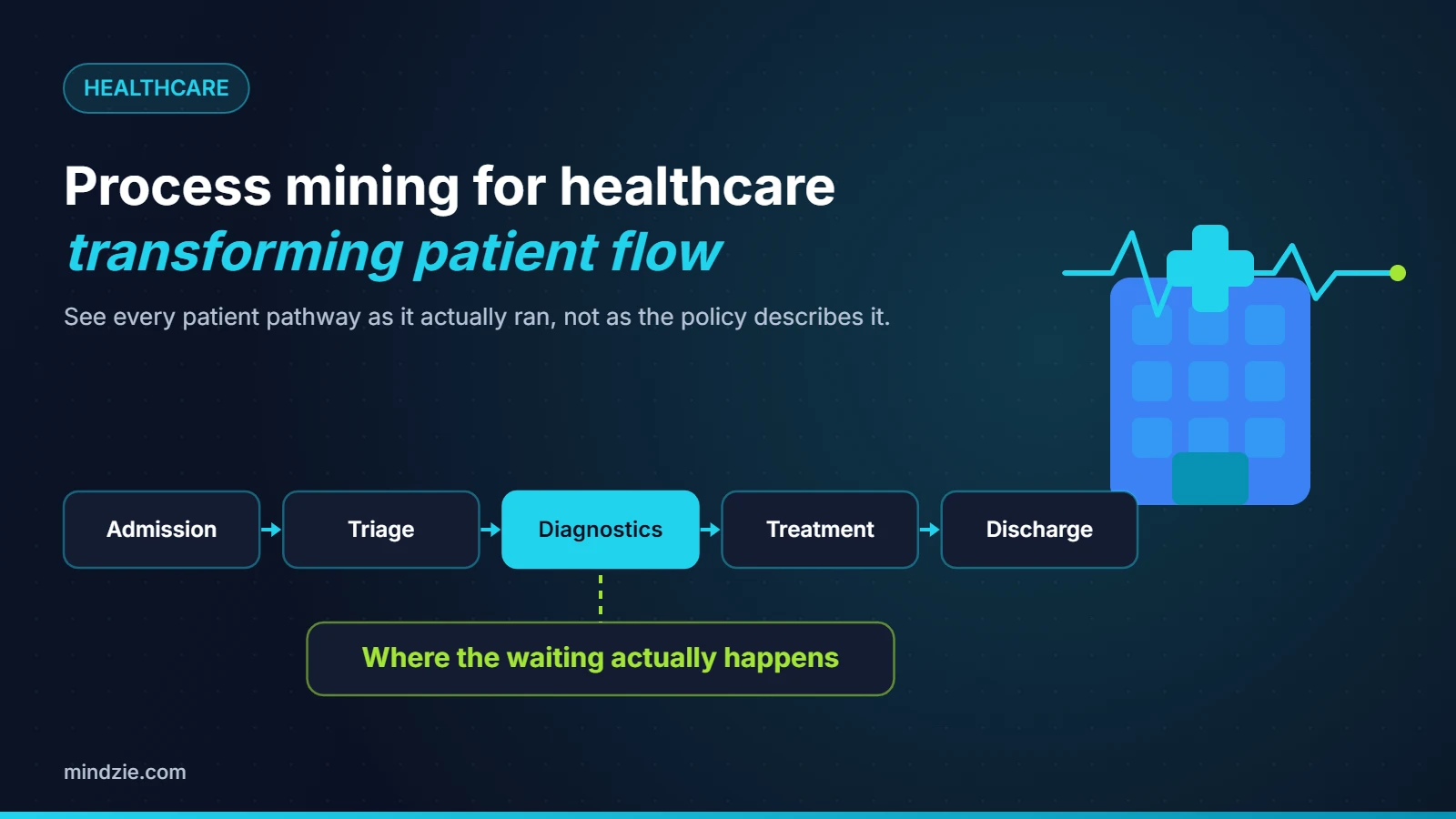
This happens because the patient is the only thing that crosses all the boundaries, and no single system follows them the whole way. Each department sees a slice, does well against its own slice, and hands the patient on. The waiting accumulates in the handoffs.
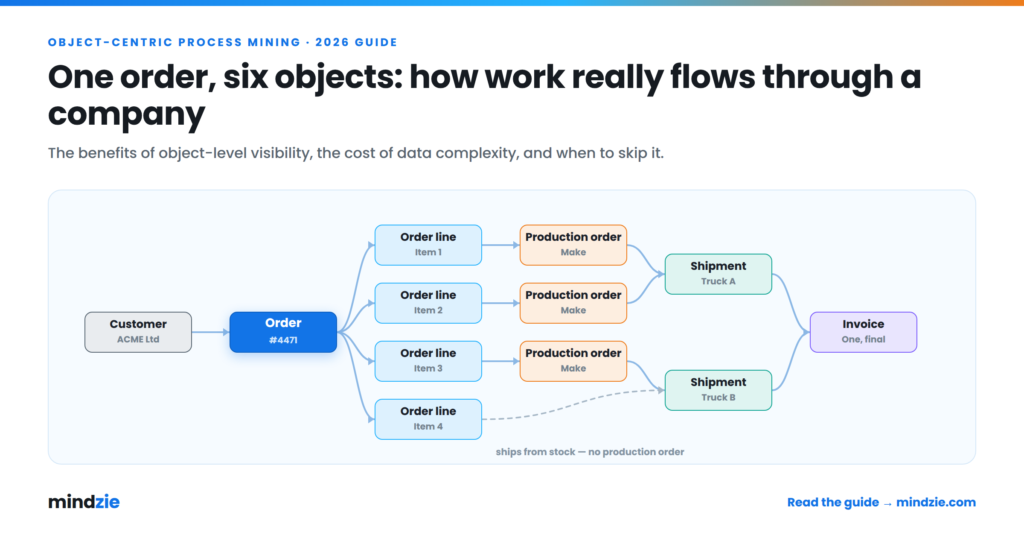
Process mining works from the patient as the unit of analysis rather than the department, which is why it surfaces delays that departmental reporting is structurally incapable of showing. When one entity creates several others that travel separately, such as an admission generating multiple orders, specimens, and results, object centric process mining keeps those relationships intact instead of flattening them into one timeline.
What process mining reveals about patient flow
The waiting between steps, not inside them
The single most common finding is that treatment time is fine and waiting time is not. Work happens quickly once it starts. The hours and days accumulate in queues: waiting for a bed, waiting for a consult, waiting for a result to be reviewed rather than produced. Because process mining measures the interval between activities across the whole pathway, that waiting becomes visible and attributable for the first time.
How many different ways the same pathway actually runs
Ask a clinical team to describe the stroke pathway or the elective hip pathway and you will get one diagram. Mine the data and you typically find dozens or hundreds of variants. Most are harmless. A handful account for a disproportionate share of delay, readmission, or cost, and those are where improvement work belongs.
Where the pathway departs from the protocol
Conformance checking compares real cases against the agreed pathway and counts the departures: steps skipped, steps repeated, steps performed out of order. For clinical governance and accreditation this replaces a sampled chart review with a full population view, which is the same shift that internal audit teams are making in finance.
What the bottleneck is costing
Once the pathway is measured you can attach numbers to it. How many patients pass through the constrained step, how long they wait, what that does to length of stay and therefore to bed availability. That turns an improvement proposal into a business case rather than an opinion.
Where hospitals apply it first
- Emergency department flow. Triage through to admission or discharge, looking at boarding time, repeat assessments, and the decision points where patients stall.
- Bed management and discharge. Discharge is the most common constraint in the whole hospital and one of the most fixable. Process mining shows how much of the delay is clinical and how much is waiting on paperwork, transport, pharmacy, or a signature.
- Operating room utilisation. Comparing scheduled against actual start and finish times, and quantifying turnover, exposes where list time is genuinely lost rather than where people assume it is.
- Oncology and other multi step pathways. Long pathways with many handoffs between diagnostics, multidisciplinary review, and treatment are where cumulative waiting does the most clinical harm.
- Outpatient and referral pathways. Referral to first appointment to follow up, including the patients who fall out of the pathway entirely and are never chased.
The obstacles worth planning for
Data quality comes before analysis
Healthcare event data is messy in predictable ways: activities recorded at the time of documentation rather than the time of care, identifiers that change when a patient moves between systems, and free text where a coded field would help. None of this is fatal, but it is work, and it belongs at the start of the project rather than as a surprise in week six. Data Designer exists for exactly this stage, connecting the source systems and shaping the records into usable event logs.
Privacy is a deployment decision, not a policy document
Patient data carries obligations under HIPAA, GDPR, and national equivalents, and the safest answer to most of them is architectural. Running the analysis inside your own environment means the raw event data never leaves your control in the first place. That is why on premises deployment is the default request from most health systems, and why it is a first class option rather than an afterthought. If you are weighing the trade offs, cloud versus on premises covers them in more detail.
It is a clinical project, not an IT project
The analysis is only half of it. The findings have to be read by people who understand why a pathway looks the way it does, because the data will show you variation that is clinically appropriate alongside variation that is waste, and only a clinician can reliably tell you which is which. Projects that stay inside IT produce interesting maps. Projects that pair an analyst with a clinical lead produce changes.
How to scope a first project
- Pick one pathway with a known problem. Not the whole hospital. One pathway where somebody can already tell you the complaint, such as discharge delay on a specific ward or emergency department boarding.
- Find the systems that timestamp it. Usually the patient administration system plus one or two others such as order communications or theatre scheduling.
- Build the event log and check it against reality. Show the discovered map to the clinical lead. If it does not look like their ward, the data needs work before the analysis means anything.
- Quantify the biggest gap. How many patients, how much time, what it costs in bed days.
- Change one thing and keep measuring. The advantage of a mined pathway is that it refreshes. Once the log is built, the same analysis reruns, so improvement becomes monitored rather than claimed.
A focused first project on a single pathway generally moves faster than teams expect, and the limiting factor is almost always data access rather than analysis.
Frequently asked questions
What is process mining in healthcare?
It is the use of timestamped event data from hospital systems to reconstruct how patients actually moved through care, then analyse that reconstruction to find delays, variation, and departures from the intended pathway. It works from the full population of cases rather than a sample.
What data do you need to start?
At minimum a case identifier, an activity name, and a timestamp, for each event. In practice that comes from the patient administration system and whichever clinical systems timestamp the steps in the pathway you are studying.
Is patient data safe?
It can be, and the deployment model is the main lever. Running process mining inside your own infrastructure means identifiable event data never leaves your environment. Analysis can also run on de identified identifiers, since the technique needs a consistent case key rather than a name.
How is this different from the reporting we already have?
Existing reporting measures departments and averages. Process mining measures journeys and sequences. That is why it finds the waiting between departments, which is exactly the part that conventional reporting is not structured to see.
Which pathway should we start with?
Start where there is an acknowledged problem, an owner who wants it solved, and reliable timestamps. Discharge and emergency department flow are the most common starting points because all three conditions are usually met.
Where this leaves you
Patient flow problems are rarely a mystery to the people living them. Staff usually know where the pathway sticks. What they often lack is the evidence to size the problem, the precision to say which of several suspected causes is the real one, and a way to show that a change actually worked. Process mining supplies all three from data the hospital is already generating, which is what makes it a practical improvement tool rather than another analytics initiative.
See how mindzie applies to healthcare operations, read more process mining use cases across industries, or book a demo to walk through one of your own pathways. You can also create a free account and start with your own data.