
On-Premises Process Mining Deployment
Enterprise process intelligence platform inside your firewall
For organizations with strict security, sovereignty, or compliance requirements, mindzie deploys directly into your own infrastructure. Get full process intelligence capabilities across your business operations with built-in process mining, BPMN modeling, Data Designer ETL, and AI-powered insights.
Why on-premises
When process data needs to stay under your control
The data behind process mining often comes from sensitive ERP, CRM, finance, service, and operational systems. For many enterprises, event log data, BPMN models, and process analysis need to stay within the same infrastructure where the work is managed. On-premises process mining gives IT and data teams more control over how process information is stored, accessed, reviewed, and protected.
AI can add value to process intelligence, but many organizations need clear boundaries around what data AI can access. mindzie’s AI agents and Copilot can be configured with an on-premises large language model server, so teams can ask questions, review recommendations, and analyze business processes while keeping prompts, responses, and sensitive operational data inside the network.
Secure process mining gives stakeholders a clearer way to review data residency, access controls, auditability, and internal policy requirements before the system goes live. This helps teams support regulatory compliance while still using process insight to improve operations.
Cloud deployment can work well when fast rollout and vendor-managed updates are the main priorities. But some business processes involve regulated records, internal security rules, or architecture requirements that call for tighter control. In those cases, on-premises deployment keeps process mining software closer to the existing systems and teams responsible for the data.
Full platform
The same enterprise-grade capabilities deployed in your environment
On-premises process mining is not a limited version of mindzie. The platform brings business process management, AI agents, and automation support into your infrastructure with the same advanced technologies available in cloud deployment.
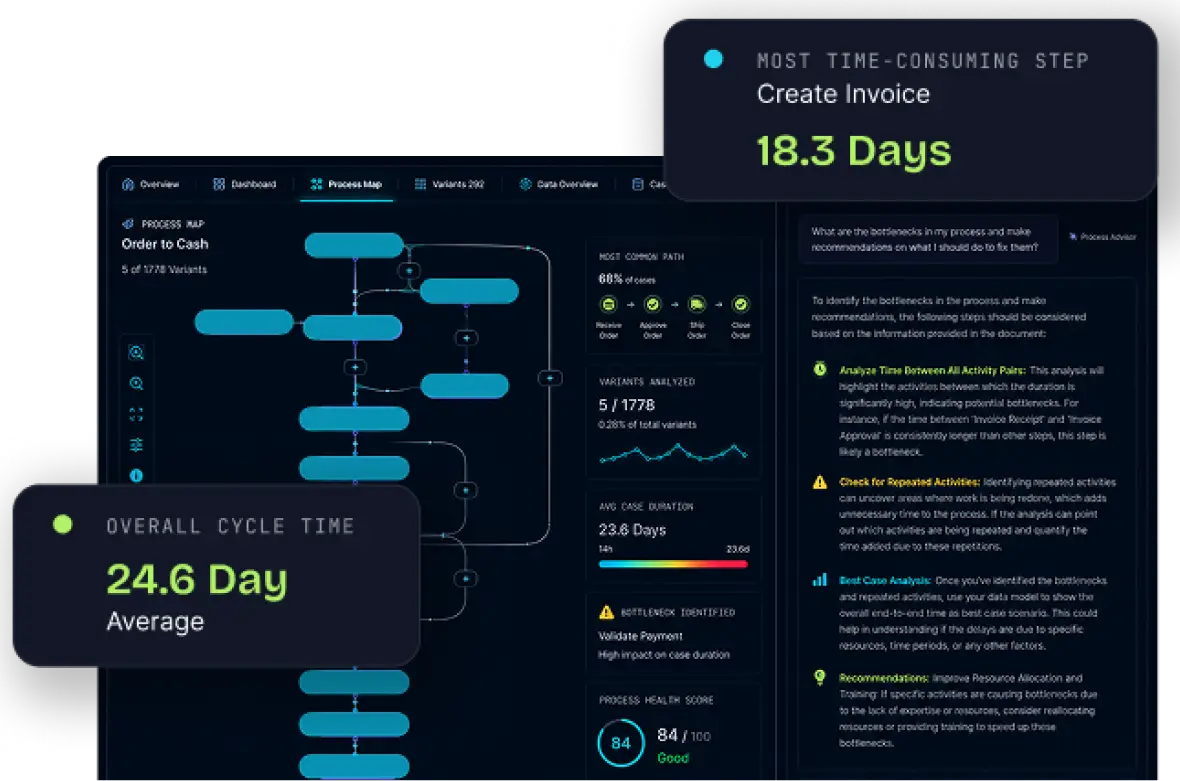
mindzie uses automated process discovery to visualize process flows using event logs, uncover real process paths, identify bottlenecks, explain deviations, and reveal which activities are strong candidates for automation inside your infrastructure.
On-premises BPMN 2.0 gives teams a structured way to design, manage, and refine their business processes by comparing planned workflows against real-world execution data from day-to-day operations.
The AI Copilot helps teams explore process intelligence, generate recommendations, and support analysis while using a local LLM inside your own network.
Real-time monitoring tracks SLAs, cases, and process deviations across operational processes, helping teams respond before delays affect performance or service quality.
AI reports, dashboards, KPIs, and Python scripting give analysts, managers, executives, and business users practical insight into performance and priorities.
Data Designer connects to enterprise systems inside your network and transforms raw records into structured event logs ready for accurate process analysis.
The automated actions engine turns process conditions into governed webhooks, API calls, or agent actions, helping teams act faster while preserving oversight.
The Model Context Protocol (MCP) server exposes approved business context and process intelligence to AI agents running inside your network and under your access controls.
Task mining reveals manual effort, application switching, and task-level friction so teams can find stronger automation opportunities and reduce operational waste.
Process simulation models propose changes before implementation so teams can evaluate their impact on cycle time, workload, resource allocation, and process performance.
Industries
Built for industries with strict data security requirements
mindzie supports self-hosted process mining and private cloud process mining for organizations that need tighter control over data, infrastructure, and compliance.
Don’t see your industry?
mindzie supports process intelligence across many enterprise environments where data control matters. Explore our industry solutions to see how process mining can support your workflows, compliance requirements, and operational goals.
View all industries