
AI Agents for Process Mining and Enterprise Automation
Your agents are only as good as the processes behind them
Every enterprise is racing to deploy AI agents. However, few are giving these agents what they need most: a grounded understanding of how the business actually runs. mindzie is the AI-powered process intelligence layer that helps agents understand how business processes move, where exceptions happen, and which actions are safe to take.
The problem
Agents without process context create work, not value
An AI agent that does not understand your workflows, SLAs, approval rules, or exception paths cannot support reliable decision-making. Instead of reducing effort, it may create more human intervention, more review work, and more uncertainty around which action should happen next.
Most process documentation describes the intended workflow, not the exceptions and delays that happen every day. Process mining offers a clearer view by analyzing event logs to show how business operations actually run.
A workflow may look simple in a diagram but become much more complicated in practice. Process discovery reveals the real steps, variants, and exceptions agents need to understand before recommending action.
When AI recommends or triggers an action, teams need to know what process step, rule, and data shaped that decision. Clear process context makes agent behavior easier to review, govern, and explain.
A delayed invoice, a blocked order, or an at-risk SLA can build quietly across several stages. Current process signals help teams act earlier, before process delays affect performance or customer experience.
The mindzie approach
Three ways mindzie makes your agents production ready
mindzie helps teams bring AI into operations by integrating process mining with governed process context and controlled automation.
The Model Context Protocol (MCP) server lets approved AI tools request process information from mindzie without giving them direct access to every enterprise system. An agent can ask about approval rules, SLA risk, case status, or exception paths, then use that context to recommend the right next step. This helps enterprises connect AI to real business workflows while keeping access controlled, governed, and easier to audit.
AI agents need more than a task description. They need to understand what the process is supposed to do, whether the current case is normal or risky, and where the issue began. mindzie provides that context by combining process models, process mining, live case status, and performance signals, giving agents the information needed to support practical process improvements.
AI process automation watches for specific process conditions, such as a delayed invoice, an SLA risk, a skipped approval, or a case moving into an unusual path. When that condition appears, mindzie can trigger the right agent with the details it needs to respond.
The process context graph
The process context graph every AI agent project needs
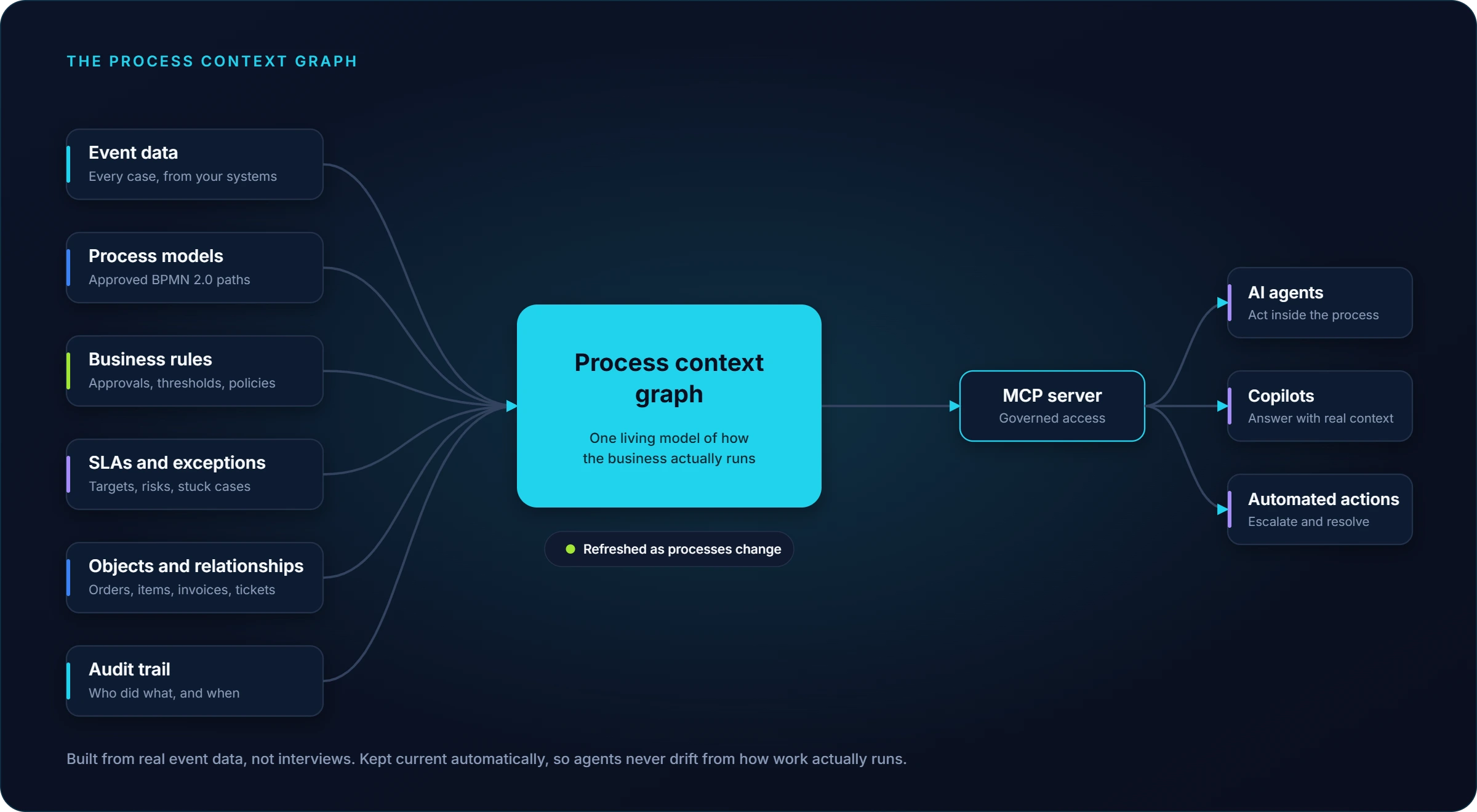
An AI agent is only as reliable as its understanding of the process it works in. mindzie builds a process context graph from the event data your systems already record, then connects it to the approved BPMN models, business rules, SLAs, object relationships, and audit trail that govern the work. Agents, copilots, and automated actions read that graph through the MCP server, so every decision is grounded in how the business actually runs today, not how someone described it in a workshop.
Use cases
What you can build with process-aware
AI agents
mindzie gives agents the process context to support detailed analysis, identify bottlenecks, and guide the next best action across operations, finance, IT, shared services, and supply chain teams.
The agent reviews the order, fulfillment, invoicing, dispute, and collections history to identify where the delay started. It can then recommend the next action for finance or collections based on the current case status.
A stalled invoice may be waiting on a missing receipt, a purchase order mismatch, or an approval that never moved forward. The agent can identify the likely cause and route the case to the right owner with the relevant process context.
When a ticket starts following a high-risk path, the agent can summarize what has happened so far, identify where momentum was lost, and suggest whether escalation, reassignment, or additional information is needed.
Repeated rework often points to unclear rules, inconsistent handoffs, or a task that should be automated. The agent can help explain the pattern and recommend whether the step needs review, standardization, task mining, or automation.
An unusual request path can signal a workaround, training gap, or exception that needs closer attention. The AI agent can compare the case against expected handling and help teams bring the work back into a more consistent flow.
Supply chain delays often build across procurement, inventory movement, fulfillment, and delivery exceptions. The agent can connect the current issue to possible downstream impact so teams can act before service or customer delivery is affected.