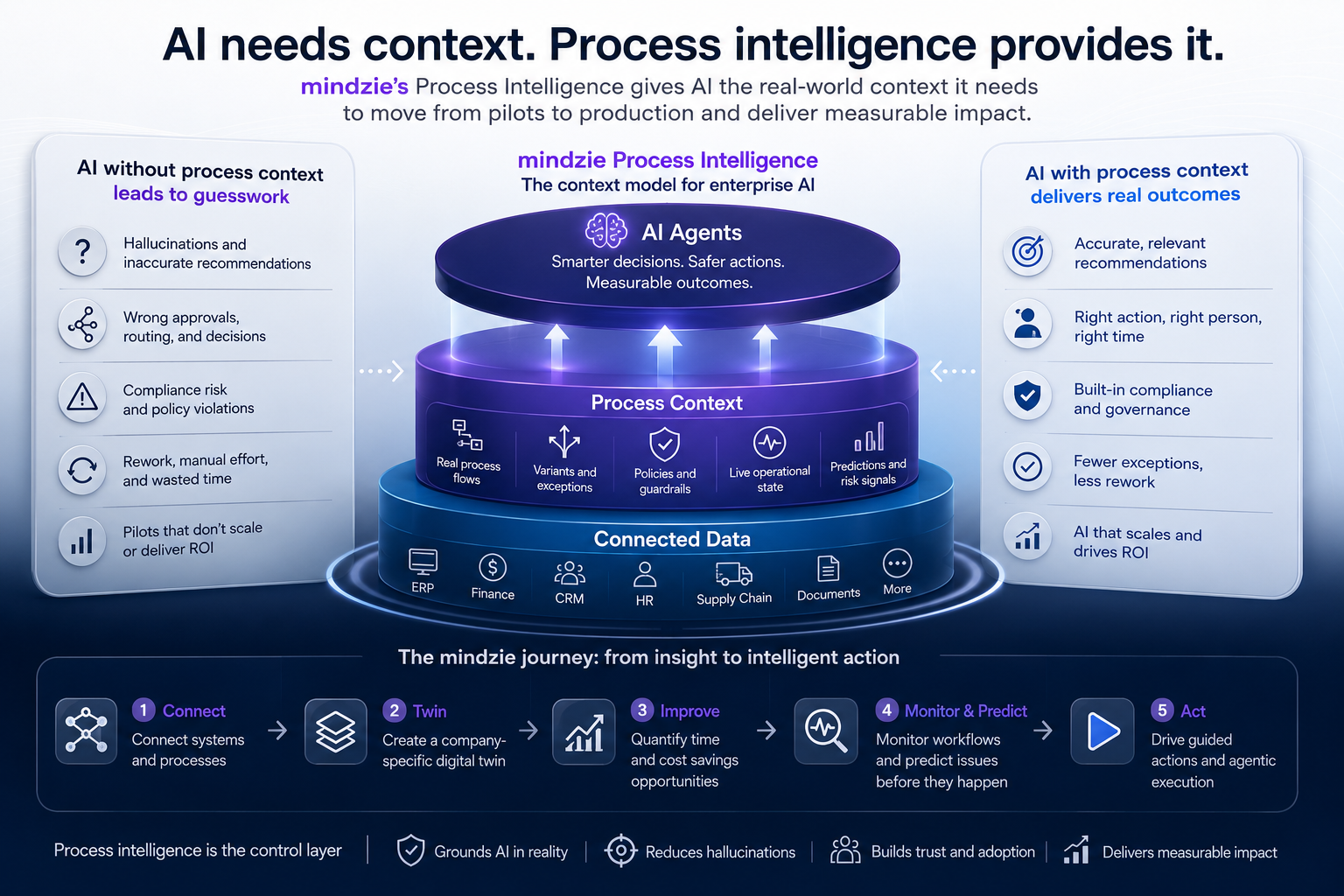

Enterprise AI is entering a new phase.
For the past few years, many organizations have experimented with copilots, assistants, and AI agents. These pilots have helped teams explore what is possible, but many have struggled to move from interesting demonstrations to measurable business impact. The issue is not always the AI model itself. The issue is context.
AI can only make useful decisions when it understands how the business actually works.
That is where process intelligence becomes essential.
AI Without Process Context Is Guessing
Every business runs on processes. Orders are approved. Claims are reviewed. Invoices are matched. Loans are originated. Inspections are scheduled. Exceptions are escalated. Work moves across people, systems, policies, and decisions every day.
The challenge is that most companies do not have a living view of how those processes actually run. Documented process maps often become outdated quickly. Variants appear. Workarounds develop. Bottlenecks shift. Policies change. The result is a gap between the way the process is supposed to work and the way it really works.
When AI operates without that context, it is left to infer too much. It may generate a response that sounds right but does not match the company’s process, policy, SLA, exception path, or approval logic. In practical business terms, that creates hallucinations, rework, compliance risk, and frustration for the teams that have to clean it up.
mindzie’s point of view is simple. AI does not just need more data. It needs process context.
Process Intelligence as the Context Model for Enterprise AI
mindzie provides companies with a process aware intelligence platform that turns how the business actually works into a living, measurable asset. It connects to existing systems, reconstructs real process flows, identifies variants and bottlenecks, compares actual execution to the designed process, monitors performance, and provides the operational context AI needs to act responsibly.
This creates a practical context model for AI. Not a generic understanding of how procurement, claims, finance, or service operations should work in theory, but a company specific understanding of how work actually moves through the organization.
That context includes:
Real process flow
Which steps happen, in what order, across which systems and teams.
Variants and exceptions
Where cases deviate, loop, stall, rework, or require manual intervention.
Policies and guardrails
Which approval paths, thresholds, SLAs, segregation of duties rules, and compliance requirements matter.
Live operational state
Which cases are healthy, which are at risk, and which need attention now.
Predicted outcomes
Where delays, breaches, exceptions, and missed value are likely to occur before they become business problems.
This is the missing layer between enterprise data and enterprise AI.
Reducing Hallucinations by Grounding AI in Reality
In consumer use cases, a hallucination may be inconvenient. In enterprise operations, it can be expensive.
An AI agent that misunderstands an approval path can route work incorrectly. A copilot that ignores SLA status can recommend the wrong priority. A recommendation engine that does not understand policy exceptions can create compliance exposure. An automation that treats every case the same can accelerate the wrong work.
mindzie reduces this risk by grounding AI in the actual process. The platform gives AI access to the same process intelligence that business teams need to operate effectively. That includes the end to end flow, the current process state, historical variants, KPI signals, policy context, and confidence thresholds.
In mindzie’s procurement AI framework, the sequence matters. Companies start with trusted event data, move into process understanding, monitor performance and compliance, then activate predictive AI and AI agents. The framework emphasizes that AI works best when it is grounded in real process behavior, live operational signals, and clear policy guardrails.
That is how organizations move from AI that sounds intelligent to AI that is operationally useful.
From Hindsight to Insight to Foresight
Process intelligence gives organizations a maturity path for AI adoption.
First, hindsight. Companies see what really happened. They discover bottlenecks, rework, variants, and root causes across the full process.
Second, insight. Teams monitor the business continuously. They track SLAs, cycle time, compliance, exceptions, and process health in near real time.
Third, foresight. AI predicts what is likely to happen next. It identifies at risk cases, likely SLA breaches, potential exceptions, and missed value opportunities before they escalate.
Finally, action. AI agents can recommend, guide, or automate next steps within defined guardrails.
This progression is critical. Too many AI programs start with action before the company has established visibility, control, and trust. mindzie helps organizations build the foundation first, so AI can act with confidence later.
The Bridge From AI Experimentation to ROI
Enterprise leaders are asking a more practical question about AI today. Not “Can we build a pilot?” but “Can we deploy AI in a way that improves cost, speed, compliance, service, and productivity?”
That requires more than a model. It requires an operating context.
mindzie helps create that bridge by connecting process data across systems, discovering how work really happens, monitoring performance continuously, predicting risk, and enabling governed AI action. In one enterprise process improvement example, mindzie unified process visibility across multiple enterprise systems, supported deep analysis of cycle time, SLA compliance, rework, and conformance, and enabled continuous monitoring with proactive alerts.
This is the foundation companies need as they move from AI pilots to real world use. AI becomes more valuable when it understands the process. It becomes more trusted when it can explain why a recommendation was made. It becomes more scalable when it operates inside the policies, thresholds, and controls that define how the business should run.
AI Needs to Understand How Work Should Work
The future of enterprise AI will not be defined only by bigger models. It will be defined by better context.
AI agents need to know the difference between a standard path and an exception. They need to understand when a case is late, when a policy applies, when a human should be involved, and when an action is safe to automate. They need to understand not only what has happened, but what should happen next.
That is what mindzie provides.
By combining process modeling, process mining, monitoring, predictive intelligence, and governed action, mindzie gives organizations a context model for real operational AI. It helps companies reduce hallucinations, improve trust, and move AI from isolated pilots into the everyday flow of work.
For companies ready to turn AI ambition into measurable impact, process intelligence is not just a supporting capability. It is the foundation.