Working out process mining cost is harder than it should be, because the license is only part of it. Pricing models differ fundamentally between vendors, some charging by data volume and others by user, and implementation effort varies more than either. This guide breaks down both, including the costs that tend to surface late.
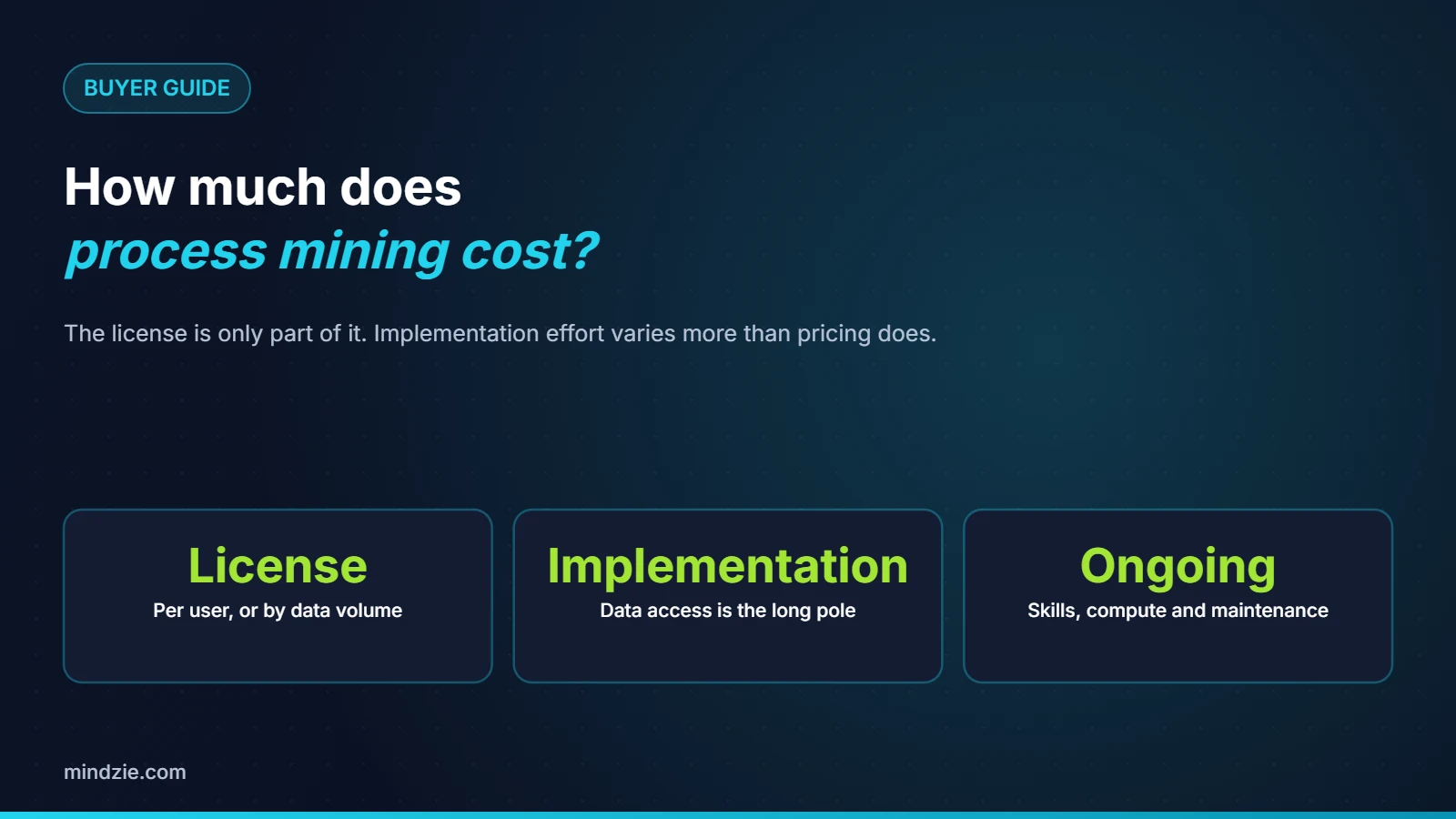
Unraveling the true investment required for process mining can be complex. Let’s dive into the costs associated with licensing and implementation, and also explore a budget-friendly alternative. Get ready for some insightful revelations.
The Value Proposition of Process Mining
The allure of process mining lies in its ability to decode the intricate dance of business processes, leveraging a mix of data mining and process analysis. This innovative approach helps businesses visualize their operational flows, pinpoint inefficiencies, and unearth opportunities for enhancement.
In our data-saturated era, the potential for process optimization through process mining is immense, promising not just streamlined operations but also a healthier bottom line. But what’s the catch in terms of investment?
Deciphering Process Mining Pricing Structures
The market has a few leading process mining tools, each with its unique pricing strategy. Whether you’re a behemoth enterprise or a small-scale operation, you’ll encounter a variety of pricing models. Here’s a snapshot:
Software as a Service (SaaS) – This model is gaining traction in the process mining sphere, offering users access to software through a subscription, usually on a monthly or annual basis. It’s appealing for its operational flexibility and low initial investment, with the added perks of regular updates and cloud-based hosting.
Usage-Based Pricing – Costs here fluctuate based on the extent of software usage, which could be measured in data volume, user count, transaction numbers, etc. It’s common to see a blend of SaaS and usage-based pricing in enterprise-level process mining solutions.
Tiered Pricing – Under this model, software offerings are segmented into levels, with each tier unlocking more features and capabilities. For scalable implementations, some process mining providers incorporate tiered pricing within their SaaS offerings.
Perpetual License – This traditional model involves a one-off purchase, granting indefinite software access. Though less prevalent in process mining, it involves an upfront cost plus potential annual fees for ongoing support.
In essence, the entry point for process mining can be seen as the platform cost, regardless of the pricing model specifics.
The Financial Outlay for Process Mining
In 2023, the initial licensing fees for process mining software span from $10,000 to $150,000. Large enterprises, especially those setting up a Process Mining Center of Excellence, may see costs starting at the $1 million mark.
Is There a No-Cost Process Mining Option?
Several process mining tools offer free trials or proof-of-concept projects with project-based pricing. For a completely free solution, mindzie offers a free desktop edition which can be loaded here.
The Cost Landscape of Prominent Process Mining Tools
Pricing details for many process mining solutions are often kept under wraps, with actual costs hinging on the scale of data mining, integration, and implementation. Here’s a brief overview:
Celonis – Specific pricing details are not public, with costs tailored to the scope of implementation and potential variations for direct purchases or through partners. Celonis also offers a limited-functionality free plan.
UiPath Process Mining – Part of UiPath’s Enterprise offerings, the exact pricing remains undisclosed, with costs likely varying based on module usage and overall platform engagement.
IBM Process Mining – Priced on a SaaS basis, with final costs influenced by user numbers and project scope.
The Hidden Costs of Implementation
Beyond licensing fees, the real investment in process mining includes the time and effort required for setup. Integrating with various enterprise systems to gather event logs demands significant expertise and resources.
Implementations can stretch from 12 to 24 months, with considerable internal resource allocation. A single process analysis within the first year might incur $50-100k in related costs.
Factors Influencing Implementation Expenses
The complexity and cost of process mining are affected by the company’s data infrastructure maturity, the IT landscape, and the specificity of the processes under scrutiny.
Considering Total Ownership Costs
The full financial commitment to process mining extends beyond licenses and manpower to include maintenance, training, and additional integrations, often leading to a substantial increase in operational expenses as more processes are integrated.
mindzie: A Cost-effective, Scalable Alternative
For those deterred by the hefty price tag of traditional process mining, mindzie offers a lean solution. This process intelligence platform merges Process Mining, AI, Automated Actions, and Python Scripting with minimal resource expenditure, bypassing the complexities of data integration.
mindzie presents a cost-effective route to process insights, even in the face of complex business processes.
In Summary
This guide aims to arm you with knowledge on the financial implications of adopting process mining, paving the way for informed decisions regarding process intelligence solutions. Both traditional process mining and innovative alternatives like mindzie serve as potent tools for business process analysis, each with its own merits in the quest for operational excellence and automation.
Next steps
See mindzie pricing for our own model, or skip the conversation entirely and test it with the free desktop edition before any budget discussion.